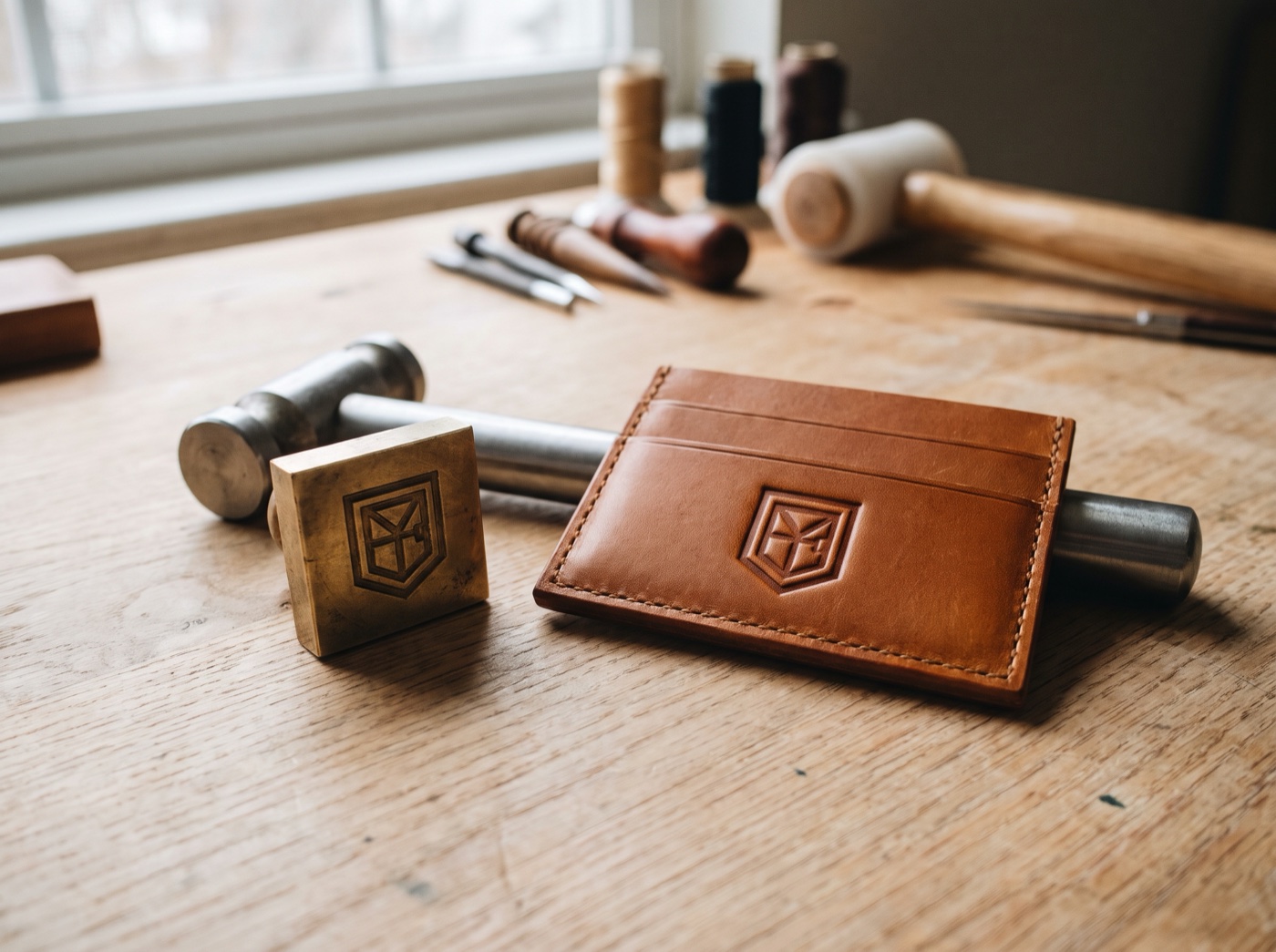
Quick Answer and Engineering Benchmarks
- Best all-round deboss die: CNC solid brass, with steep walls and a relief target of at least 2.8 mm.
- Steel (304 or tool steel) is the most wear-resistant but costs more to machine and heats up slower than brass.
- Acid-etched magnesium is the usual hot-foil die: cheap and fast, but with shallower, sloped etched walls.
- Delrin (acetal) is machinable and low-cost, but it softens with heat, so it suits cold debossing only.
- Check the geometry first: on 4–10 oz (1.6–4.0 mm) veg-tan, the same strokes ≥ 0.50 mm and gaps ≥ 0.80 mm apply to every material.
| Property | CNC solid brass | 304 / tool steel | Acid-etched magnesium | Delrin / acetal |
|---|---|---|---|---|
| Wall steepness | Steep, near-vertical | Steep, near-vertical | Sloped (etch flank) | Steep if CNC cut |
| Typical relief | ≥ 2.8 mm (our target) | Deep achievable | Usually shallower | Deep achievable |
| Heat / hot-foil stamping | Good; conducts heat well (≈ 100–120 W/m·K) | Fair; slow to heat (304 ≈ 16 W/m·K) | Excellent; standard foil die | Poor; softens with heat |
| Cold deboss on veg-tan | Excellent | Excellent | Fair to good | Good, edges round over time |
| Longevity | Decades with care | Longest | Moderate; etched edges wear | Shortest |
| Relative cost | Mid (from $69 here) | Higher | Lowest to low | Low |
Material properties are typical handbook values and general shop experience, not test results on our products. We make brass dies only; the other materials are described so you can choose honestly.
Four materials, what actually changes
Whatever the metal, a leather stamp works by compressing the surface under a raised design. Three things change by material: how steep and deep the walls can be, how the die handles heat, and how long its edges survive.
- Wall steepness controls crispness. Steeper walls put a sharper edge on the mark.
- Heat matters if you use hot-foil or heat debossing. Metals conduct heat; plastics do not.
- Longevity is edge life under repeated mallet or press impact.
CNC solid brass: the all-rounder
Brass machines cleanly, holds fine edges and takes a deep relief. It conducts heat well, so it works for heat debossing, and it is soft enough to be cut precisely but hard enough to last years in an arbor press. Our target is a relief of at least 2.8 mm, which keeps the background off the leather and helps prevent a halo around the mark.
Trade-off: it is more expensive than an etched plate, and a deep, narrow cut costs machining time.
304 and tool steel: the long-life option
Steel resists wear and impact the best, so a hardened tool-steel die keeps its edges for production runs. 304 stainless steel resists corrosion but conducts heat poorly (about 16 W/m·K versus about 100–120 for brass), so it warms slowly for heat stamping.
Trade-off: harder to machine, so cost and lead time are higher, and hardened steel is unforgiving of a misaligned strike.
Acid-etched magnesium: the foil specialist
Magnesium plates are photo-etched, which is fast and inexpensive, and the metal conducts heat well. That makes them the standard choice for hot-foil dies and flat artwork. Etching eats sideways as it eats down, so the walls slope and the relief is usually shallower than a CNC cut.
Trade-off: soft edges on a deep deboss, and etched edges wear sooner under heavy mallet use.
Delrin (acetal): cold work only
Delrin cuts cleanly on a CNC, is light and costs little. But it is a plastic: its heat conduction is about 0.3 W/m·K, it softens well below the temperatures used for foil work, and its edges round over with repeated impacts.
Trade-off: fine for a few cold impressions or prototypes, a poor choice for heat stamping or long runs.
How to choose, in one line each
- Clean, deep deboss for a wallet, belt or tote: CNC brass.
- Production runs of thousands: hardened tool steel.
- Hot-foil artwork: etched magnesium.
- Quick prototype, cold only: Delrin.
Before any metal is cut, check your artwork: strokes of at least 0.50 mm and gaps of at least 0.80 mm at final size apply to all four materials.
Quick questions, straight answers
What is the best material for a custom leather stamp?
For a clean, deep deboss on 4–10 oz veg-tan, CNC solid brass is the best all-round choice. Steel lasts longest, magnesium suits hot-foil dies, and Delrin suits cold prototypes.
Is a magnesium stamp good for leather?
Etched magnesium is the standard for hot-foil work and conducts heat well. Its etched walls are sloped and shallower than CNC brass, so it gives a softer deep deboss.
Can I use a Delrin stamp for heat stamping?
Not recommended. Delrin (acetal) conducts heat poorly and softens with heat, so it suits cold debossing and prototypes only.
Do line width rules change by material?
No. On 4–10 oz veg-tan we screen raised strokes at 0.50 mm or more and gaps at 0.80 mm or more at final size, whatever the material.
Choose the brass, then check the mark.
See the custom deep-engraved brass leather stamp, cut to a ≥ 2.8 mm relief target, and preview your maker’s mark on leather before any metal is machined.