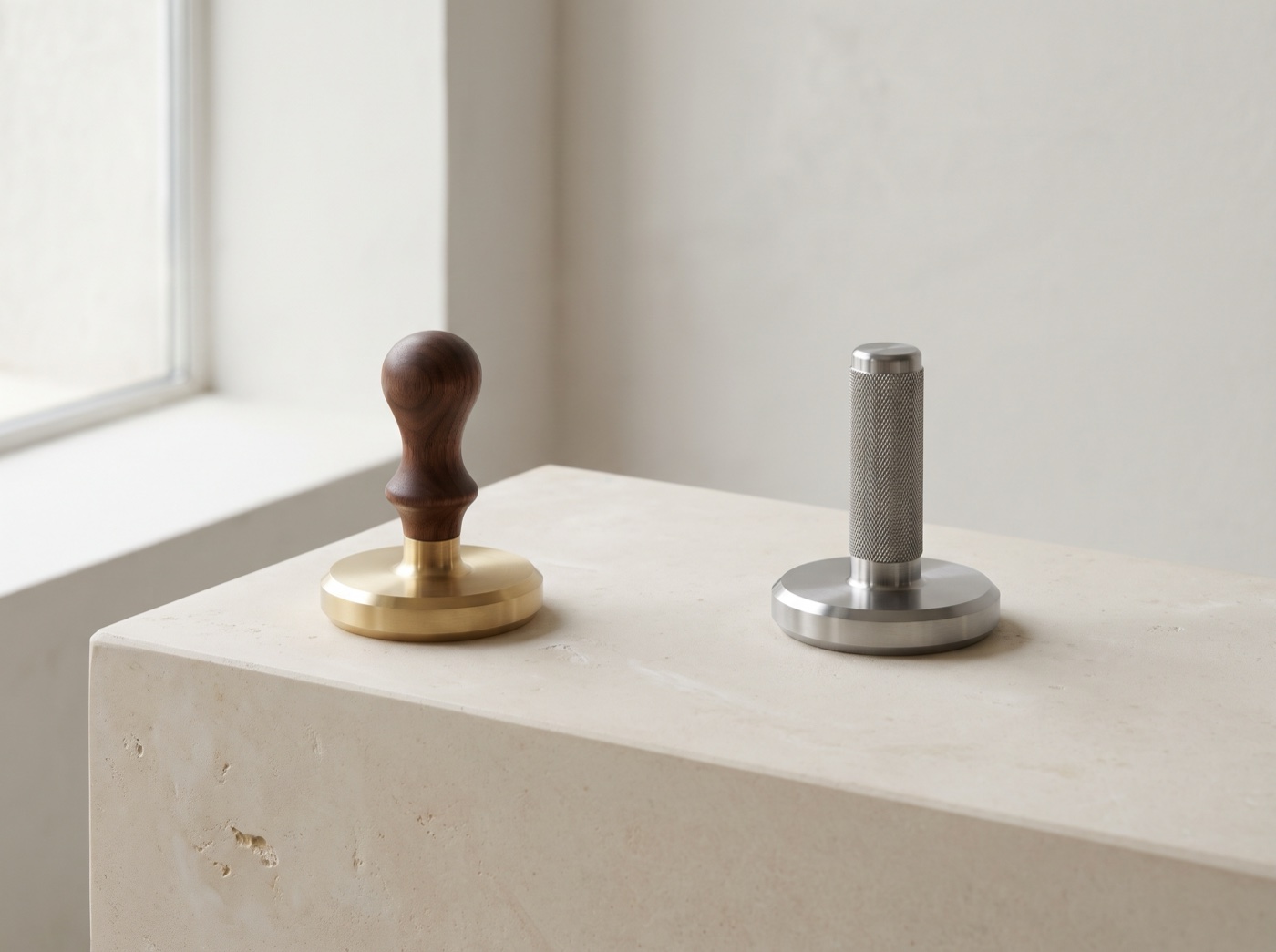
The short answer
- Speed on ice: brass needs about 2–3 s of contact; 304 stainless steel about 4–5 s, because steel conducts heat roughly six times more slowly.
- Finish: brass warms and develops patina; 304 stays bright and takes commercial washdown without changing character.
- Price: brass from $69 / $89 / $109 by face size; 304 is +$15 on each. Extra M8 interchangeable heads are +$49.
- Pick brass for home bars and weddings; pick 304 for high-volume commercial service where durability and washdown matter more than seconds per cube.
- Either way: stamp plain-water ice before the drink is poured.
Lead-free brass vs. 304 stainless steel, side by side
Both materials make a sharp impression when the artwork, ice and technique are right. They differ in how fast they move heat, how they age and how they behave under a busy bar’s cleaning routine. Here is the honest comparison, including where 304 wins.
| Lead-free (bismuth) brass | 304 stainless steel | |
|---|---|---|
| Thermal conductivity (typical) | On the order of 100 W/m·K, varying by alloy | About 15–16 W/m·K |
| Dwell on plain-water ice | About 2–3 s | About 4–5 s |
| Finish over time | Warm gold that softens into a patina with use | Bright, neutral and consistent; little visible ageing |
| Commercial washdown | Hand-wash, rinse and dry; patina is part of the look | Bright commercial finish that tolerates frequent washdown; still wash and dry after use |
| Acidic or flavoured ice | Copper alloy: keep to plain-water ice | More resistant, but we still recommend plain-water ice |
| Price (proposed, USD) | From $69 / $89 / $109 by face size | +$15 on each size (from $84 / $104 / $124) |
| Second custom head (M8) | +$49 | +$49 |
| Handle | Turned walnut | Knurled solid 304 steel |
The stainless option costs $15 more than brass at every face size, and both use the same M8 head thread. Swapping material is a small step, not a different product line. Prices are proposed and may change before launch.
Service speed: 2–3 seconds versus 4–5
An ice stamp melts its pattern in by delivering heat from the metal into the ice. Brass alloys move heat roughly six times faster than 304 stainless steel, so a brass stamp leaves a mark in about 2–3 seconds while 304 needs about 4–5. Those are starting points for a clean, room-temperature stamp on tempered plain-water ice; test on spare cubes rather than borrowing one material’s timing for the other.
Illustrative arithmetic: roughly two extra seconds per cube adds up to about seven minutes of pure stamping time across 200 cubes. That is negligible at home and for a wedding of 100–150 guests, and it is real in a busy bar, where a second stamp or a second head is a simple fix.
Patina versus bright washdown finish
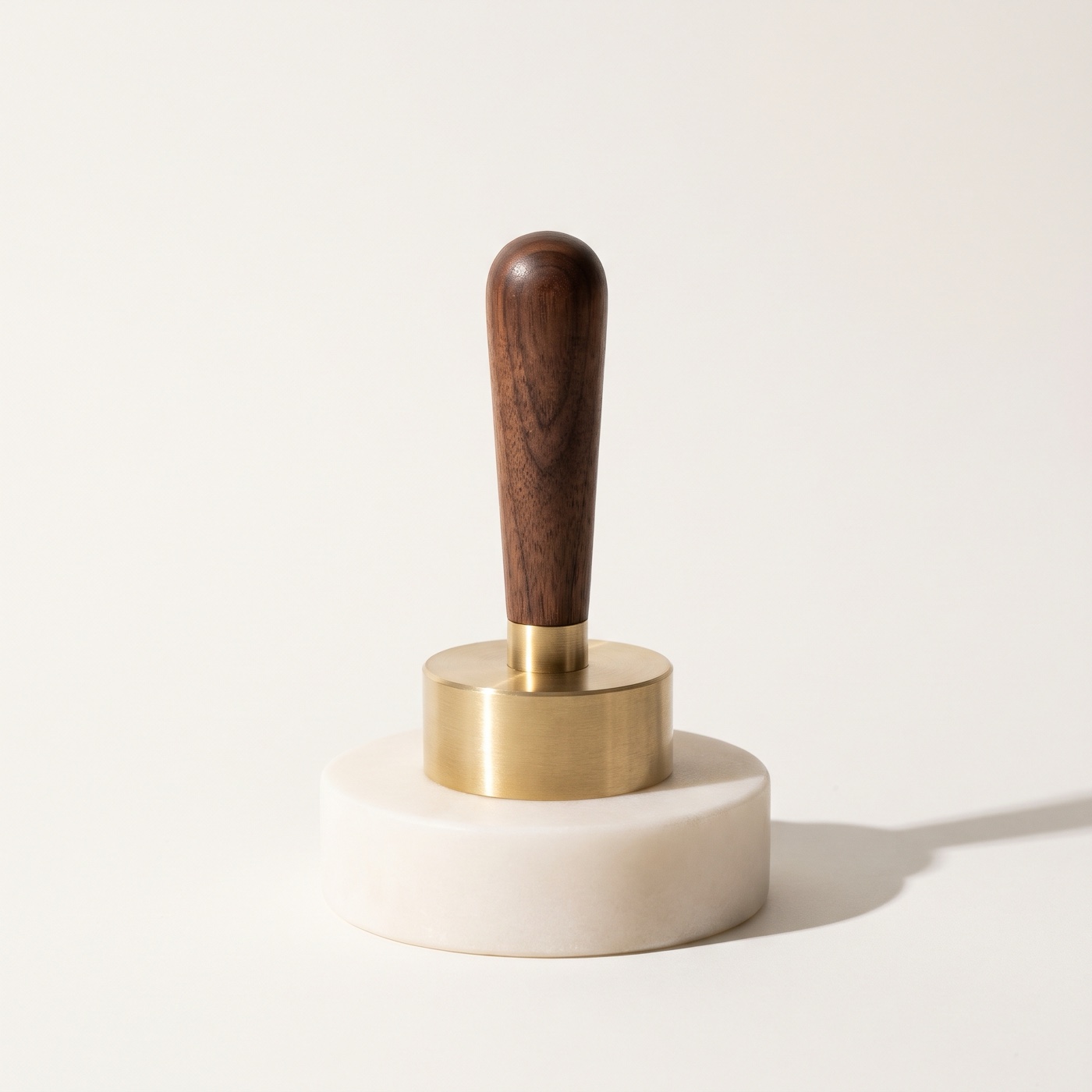
Brass is a living material. With handling and washing it moves from bright gold toward a softer, deeper tone; many owners prefer that, particularly for weddings and home bars where the stamp is part of the keepsake. Polishing is optional and a matter of taste.
304 stainless steel stays visually constant. Its bright finish suits a back bar that is cleaned several times a night, and it will look the same in a year as in a week. It will not warm in tone, which is the point for some bars and the drawback for others.
What “lead-free” means here
Lead-free here is a metallurgical statement, not a certification: our target alloy is a bismuth lead-free eco-brass, and an optical-spectrometer reading of a supplier alloy sample came in at about 0.0022% lead (≈ 22 ppm) against the 0.25% (2,500 ppm) NSF/ANSI 372 drinking-water plumbing threshold, used here only as a reference benchmark. That is a sample reading, not a batch report: every production batch is spectrometer-checked and its batch sheet published before dispatch.
That is about the alloy. It is not a food-safety certification, and it does not remove brass’s limit with acidic contact: keep brass to plain-water ice, stamped before the drink is poured. 304 stainless steel contains no added lead and, with a mill certificate for the grade, answers that question differently. Read the full context in our lead-free brass vs. C36000 guide.
Decision matrix: home bar, wedding, or high-volume bar
Match the material to how the stamp will actually be used.
| Use case | Better fit | Why | Watch for |
|---|---|---|---|
| Home bar | Lead-free brass | Fast, forgiving 2–3 s contact; warm patina suits a keepsake tool | Hand-wash and dry; plain-water ice only |
| Wedding or event | Lead-free brass | Quick for a hundred cubes; monogram looks warm in photographs; 2nd M8 head (+$49) for a date or crest | Proof the monogram’s stroke width first; temper the ice |
| High-volume commercial cocktail bar | 304 stainless steel (with a second stamp or head for rush) | Bright finish tolerates repeated washdown; consistent look across shifts | Slower 4–5 s dwell; plan stamping stations or an extra head for peak hours |
| Bar with a rotating menu | Either, with M8 heads | One handle, several heads (+$49 each) in the same material | Label and store heads so menus don’t get mixed up |
Quick questions, straight answers
Is lead-free brass or 304 stainless steel better for ice stamps?
Neither is better in every case. Brass is faster on ice (about 2–3 seconds against about 4–5 seconds for 304) and develops a patina; 304 stainless steel stays bright and suits frequent commercial washdown. Home bars and weddings usually suit brass; high-volume bars often prefer 304.
Why does 304 stainless steel take longer to stamp ice?
304 conducts heat much more slowly than brass, roughly 15–16 W/m·K against about 100 W/m·K for typical brass alloys, so it delivers heat into the ice more slowly and needs about 4–5 seconds of contact.
How much more does a 304 stainless steel ice stamp cost?
Our proposed pricing is $69, $89 and $109 for brass by face size, and 304 stainless steel adds $15 at each size. A second custom M8 head is +$49. Prices may change before launch.
What does lead-free mean for your brass?
Our target alloy is a bismuth lead-free eco-brass. An optical-spectrometer reading of a supplier alloy sample was about 0.0022% lead (about 22 ppm), against the 0.25% (2,500 ppm) NSF/ANSI 372 drinking-water threshold used as a reference. It is a sample reading, not a batch report or a certification; each production batch is spectrometer-checked and its batch sheet published before dispatch.
Choose the metal, then check the mark.
Preview your logo on brass or 304 stainless steel at the finished size, with thin strokes and narrow gaps flagged before any metal is cut.