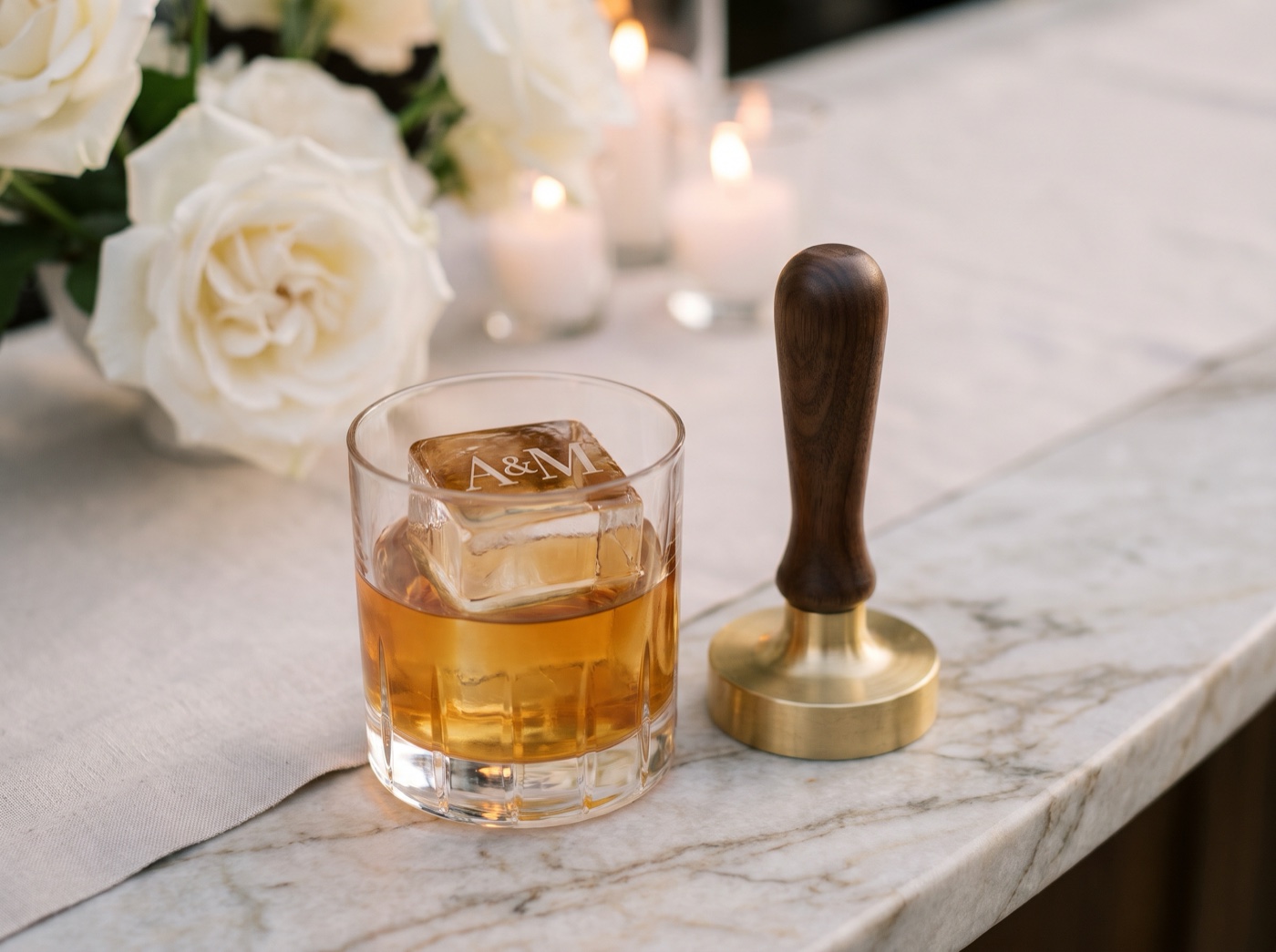
Quick Answer and Engineering Benchmarks
- Face size: 2.0 inches (50.8 mm) fits a standard 2-inch cube in a wedding rocks glass; choose 1.5 inches (38.1 mm) for small cubes or two to three initials.
- Line weight: keep every raised stroke at or above 0.50 mm and every gap at or above 0.80 mm at final size. Calligraphy hairlines under 0.50 mm disappear on melting ice.
- Font rule: pick a serif with a strong thick-thin contrast only if the thin strokes still measure ≥ 0.50 mm; otherwise pick a monoline geometric or a sturdy serif.
- Date rule: put the wedding date on a second M8 interchangeable head (+$49) so the main monogram stays usable for anniversaries.
- Proposed price: 1.5-inch $69, 2-inch $89, 2.5-inch $109.
| Design parameter | Benchmark | Why |
|---|---|---|
| Recommended face | 2.0 in (50.8 mm) | Fills a standard 2-inch cube without touching the edge |
| Smaller face | 1.5 in (38.1 mm) | Small cubes, simple initials |
| Minimum raised stroke | ≥ 0.50 mm | Thinner lines bridge shut with meltwater |
| Minimum gap between strokes | ≥ 0.80 mm | Narrow gaps fill and round off |
| Date head | Separate M8 head, +$49 | Keeps the monogram reusable |
| Relief depth target | ≥ 2.8 mm CNC | Keeps the stamp floor off the ice |
Stroke and gap values are screening guidelines applied at the finished size. Relief depth is a CNC design target; documented measurements will be published before orders open.
Why calligraphy hairlines disappear on melting ice
Script monograms usually contain hairlines, the thin connecting strokes between heavy downstrokes. A hairline under about 0.50 mm at final size cannot hold its edge: the stamp melts a shallow recess, the meltwater rounds it off, and the thin line merges into the heavy stroke beside it.
Scale matters. A script that looks elegant on a 150 mm invitation shrinks to roughly a third of its width on a 50.8 mm stamp, and a 0.60 mm hairline becomes 0.20 mm. Always judge the artwork at the size it will be made, not on the screen.
Serif vs geometric: the rules that hold up
You can use either. What matters is the thinnest stroke, not the style.
| Sturdy serif | Geometric / monoline | Delicate script | |
|---|---|---|---|
| Thinnest stroke | Often 0.50–0.80 mm after scaling | Uniform, easy to hold ≥ 0.50 mm | Hairlines frequently under 0.50 mm |
| Reads on ice | Very well | Very well, modern look | Poorly unless thickened |
| Typical use | Classic or formal weddings | Contemporary and minimalist | Invitations, not stamps |
| Our advice | Pick it with thin strokes checked | Safest first choice | Thicken hairlines or switch |
- Serifs: choose a sturdy, slightly bold face; avoid “didone” styles with razor-thin serifs.
- Geometric: monoline letters are the most forgiving; keep gaps between letters at 0.80 mm or more.
- Ampersands and dates: they are often finer than the letters; check them separately.
Why 2.0 inches (50 mm) fits standard wedding glasses
Most wedding bars pour into rocks glasses with 2-inch cubes. A 2.0-inch (50.8 mm) face gives a bold monogram without crowding the cube edge, and a little margin to allow for positioning. Measure the flat top of your cube, not just the mold size.
Choose 1.5 inches (38.1 mm) for smaller cubes or two simple initials. Choose 2.5 inches (63.5 mm) only for large format cubes.
Should the date go on a separate head? Usually, yes.
A wedding date is only right once. A monogram can be used at the wedding, the engagement party, every anniversary and every dinner afterwards. If you cut the date into the main face, the stamp is a single-use keepsake.
Our heads screw onto the handle on an M8 thread, so a second custom head for the date or a short phrase costs +$49 instead of a second $89 stamp. Each head is checked at final size and proofed separately.
Order the monogram first and the date head second. If the date is not final, you lose nothing: the monogram head works on its own.
A planner’s design checklist
- Confirm the exact letters and order: A & M, or surname initial centered.
- Choose a sturdy serif or geometric font; avoid thin script.
- Pick the size: 2.0 inches (50.8 mm) for standard rocks glasses.
- Check every stroke ≥ 0.50 mm and every gap ≥ 0.80 mm at final size.
- Decide whether the date goes on a separate +$49 M8 head.
- Preview the proof, approve the artwork, and confirm the production timeline shown before checkout.
Want a ready-made starting point? Use the wedding monogram generator or read the wedding monogram ice stamp page.
Quick questions, straight answers
What size should a wedding monogram ice stamp be?
A 2.0-inch (50.8 mm) face fits a standard 2-inch cube in a wedding rocks glass. Use 1.5 inches (38.1 mm) for smaller cubes or two or three simple initials.
Can a calligraphy monogram be used on ice?
Only if the thinnest strokes are at least 0.50 mm and gaps are at least 0.80 mm at final size. Delicate hairlines usually disappear on melting ice, so thicken them or pick a sturdier font.
Should the wedding date be on the same stamp?
We recommend a separate M8 interchangeable head (+$49) for the date, so the main monogram stays usable for anniversaries and other events.
What font works best for an ice stamp?
A sturdy serif or a geometric monoline font. What matters is the thinnest stroke at final size, not the style.
Design the monogram, then see it on ice.
Start with the generator, review the wedding page for the handoff checklist, then check your artwork at 2.0 inches in the studio.